What do the supplied Prostapure images establish?
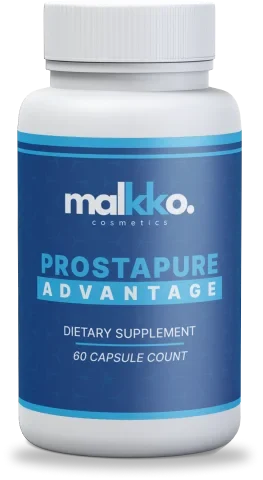
The supplied bottle artwork reads “Malkko” and “Prostapure Advantage,” describes the item as a dietary supplement, and shows a 60-capsule count. The package also contains one-, three- and six-bottle graphics and two digital-bonus images. These are promotional assets, not photographs from an independently documented purchase.
There is no readable rear-label Supplement Facts panel in the supplied files. Accordingly, this page does not invent an ingredient total, proprietary-blend weight, capsule-shell material, daily dose or list of allergens. A 60-capsule bottle does not by itself establish how many capsules someone should take each day.
The supplied pictures identify the front branding, not a complete formula. Before using any supplement, compare the delivered bottle with the current label supplied by the seller. A filename or front-package slogan is not a substitute for the Supplement Facts panel.
Which ingredients does the merchant describe?
The publicly accessible welcome page describes tannins, saponins, resveratrol and flavonoids. The merchant homepage instead includes phytosterols/campesterol. Its welcome heading refers to five ingredients, although four named groups appear in the retrieved ingredient section. These differences need a current label, not a guess. Merchant welcome page (opens a new tab) Merchant homepage (opens a new tab)
| Term in merchant copy | What is actually specified | What still needs confirmation |
|---|---|---|
| Hydrolyzable tannins | A group of plant compounds | Source plant, extract, amount and standardization |
| Steroidal saponins | A compound family | Identity, plant part, daily quantity and safety information |
| Resveratrol / Polygonum cuspidatum | A named compound and botanical source on the welcome page | Amount, form, extract specification and current inclusion |
| Flavonoids / flavanols | A broad compound category | Which flavanols, how much, and from which ingredients |
| Phytosterols / campesterol | Listed on a different merchant page | Whether present in this version; total and individual sterol quantities |
This table records marketing terms; it is not a reconstruction of the product label. It also does not imply that each term is a separate raw ingredient. One botanical extract can contain several classes of compounds. Adding together the number of headings would therefore not establish the number of distinct ingredients or the total quantity in a capsule.
A precise comparison needs a single version of the formula. Request the label for the stock that will actually ship to your address. A reseller image, an earlier landing page and a newer checkout can refer to different presentations. Until those documents agree, a confident dose-by-dose comparison would be misleading.
Why does the amount and form matter?
Research studies test defined interventions. The investigators may use a standardized extract, a particular chemical form, a stated daily quantity and a fixed treatment period. A supplement that lists a related word does not automatically reproduce that intervention. The same issue applies when the published experiment uses cells or animals rather than adults with urinary symptoms.
For a botanical, look for the Latin plant name and the part used, such as root, bark, fruit or seed. Next look for the extract amount and whether it is standardized to a measured component. A statement about a standardized percentage is not the same as an additional quantity to add on top of the extract. For example, a hypothetical 200 mg extract standardized to 10% of a constituent would provide 20 mg of that constituent; it would not provide 220 mg of extract. This arithmetic example is not a Prostapure specification.
Units also matter. Milligrams and micrograms differ by a factor of a thousand. A compound amount reported per capsule is different from one reported per two-capsule serving. A label that does not supply enough information should be marked “not disclosed,” rather than filled using another brand’s directions.
Read next: How to read a prostate-supplement label.
Does resveratrol research establish a prostate benefit?
In a four-month randomized study of 66 middle-aged men with metabolic syndrome, resveratrol at 150 or 1,000 mg daily did not reduce measured prostate volume or PSA. This was not a trial of Prostapure, and those trial doses are not instructions for taking it. PubMed 25939591 (opens a new tab)
The useful conclusion is narrower than either “all natural products work” or “every supplement is identical.” This study does not support translating resveratrol’s laboratory reputation into a prostate-shrinking promise. Its participants, product, endpoints and time frame have to remain attached to the result.
Nor can this website determine whether the current Prostapure bottle delivers either study quantity. The missing label prevents that comparison. Advertising a compound’s general scientific interest is different from documenting an effective quantity in the finished supplement. The evidence page describes this distinction in more detail.
Read next: Prostapure evidence and the ingredient-to-study gap.
Are campesterol and beta-sitosterol interchangeable?
They are not the same named substance. A marketing page that mentions campesterol should not be represented as proving a specified beta-sitosterol dose. Even a label that lists total phytosterols may leave the amount of each sterol uncertain. In an ingredient comparison, the broader blend weight and the individually disclosed quantity belong in separate columns.
This matters because some of the better-known prostate-supplement trials involved preparations containing beta-sitosterol. Their results cannot simply be transferred to any item carrying the word “phytosterols.” The study product and daily intake need to match before making a stronger inference. A phrase such as “plant sterols” is not a clinical-trial identifier.
One six-month randomized trial involving 200 men found symptom and flow improvements with its beta-sitosterol preparation, but did not show reduced prostate size. It was an ingredient-preparation study, not a trial of the Prostapure product. PubMed 7540705 (opens a new tab)
Read next: Saw palmetto versus beta-sitosterol: compare the evidence.
Which label details should a pharmacist see?
Share the whole label, not just the front image or a handwritten list of three highlighted herbs. Include serving instructions, other ingredients, warnings, the lot number and the seller’s contact information. Add the medicines, vitamins and other supplements you already use. This makes a review of duplicate ingredients and possible interactions more meaningful.
Do not assume that words such as “natural,” “traditional” or “steroidal saponins” establish safety with all medicines. The latter is a class description, not evidence that the product contains a prescribed hormone, raises testosterone or restores sexual function. This review does not establish those outcomes.
A clinician’s advice about symptoms is separate from a seller’s answer about packaging. The seller can identify capsule contents and return terms; they should not replace a medical assessment when someone has new pain, blood in urine or difficulty passing urine.
FDA supplement information (opens a new tab) NIDDK urinary-retention guidance (opens a new tab)
A precise message to request the current formula
Copy this request
Please send the current full Supplement Facts and directions for the Prostapure Advantage stock linked from your welcome page. Include the serving size, individual ingredient amounts, other ingredients, allergen information and capsule material. Please also clarify whether the formula contains resveratrol, campesterol, or both, and which lot or version the label describes.
Save the response together with the product-page URL and the date. Ask a follow-up question when the attachment does not answer the original request. A cropped front label or a restatement of the benefits is not a substitute for the panel.
When the current label arrives, compare it against the bottle delivered. A change in package colors may be a normal artwork revision, but a difference in named ingredients or directions should be clarified before use. This is also an appropriate time to check that the tamper-evident seal and expiry details are intact.
Our next revision should follow documents, not invent them. The formula table can be expanded when quantities are verified. Until then, an honest missing-data column is more useful than a polished table of assumed doses.
Read next: What a supplement laboratory report can establish.
Sources and scope
Selected sources, not a systematic review. Public seller and manufacturer pages can be cached or change. Research findings retain their population and intervention limits.
- Prostapure seller welcome page — public offer snapshot (opens a new tab)
- Prostapure merchant homepage — formula wording differs from welcome page (opens a new tab)
- Kjær et al., 2015 — resveratrol, hormones and prostate volume; PMID 25939591 (opens a new tab)
- Berges et al., 1995 — beta-sitosterol randomized trial; PMID 7540705 (opens a new tab)
- FDA: Questions and answers on dietary supplements (opens a new tab)
- NIDDK: Symptoms and causes of urinary retention (opens a new tab)